
bhalukona-jamnidih Ni-Cr-PGE License – Chhattisgarh, India
Deccan Gold is privileged to be one of the very first companies to be granted a nickel licence in India. The execution of the Bhalukona nickel licence is an exciting and significant step in Deccan Gold’s mission to make Atmanirbhar Bharat a reality, and secure supply of strategic and critical minerals for India and our ~40,000 Indian Shareholders.
Chhattisgarh Overview
Chhattisgarh is a landlocked state in Central India. It is the ninth largest state by area and the seventeenth most populous. Formerly a part of
Madhya Pradesh, it was granted statehood on 1 November 2000 with Raipur as the designated state capital.
Chhattisgarh is a resource-rich state. It has the third largest coal reserves in the country, produces 50% of the country’s cement production, and provides electricity, coal, and steel to the rest of the nation. It is third largest in iron ore production and the only state with tin production. Limestone, dolomite and bauxite are abundant and other commercially extracted minerals include corundum, garnet, quartz, marble, alexandrite and diamonds.
Licence Location
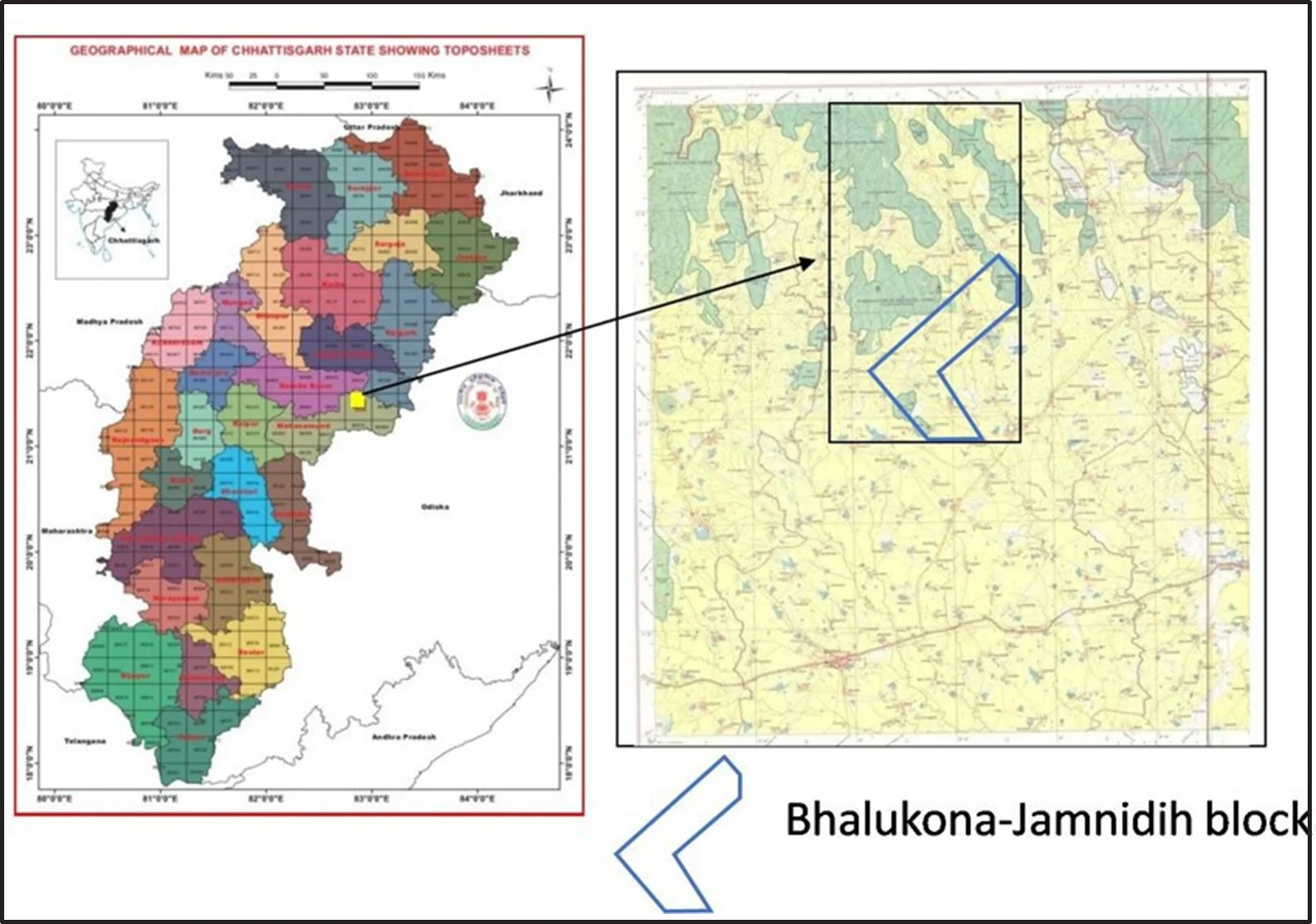
The 30 sq. km Bhalukona Nickel Block is in Basana Tehsil, Mahasamund District, Chhattisgarh State (Figure 28) and readily accessed via local roads and forestry tracks.
Approximately 10% of the licence area is covered by forestry type “open jungle” and Deccan Gold has acquired the necessary forestry approvals for non-destructive exploration activities up to and including drilling in specific areas.
The Geological Survey of India has carried out preliminary exploration and identified sulphide bearing mafic-ultramafic intrusive rocks with anomalous Ni, Pt and Pd values. This block is considered to have high potential for Ni, Cr, PGE (and possibly copper) deposits.
Geology and Mineralisation
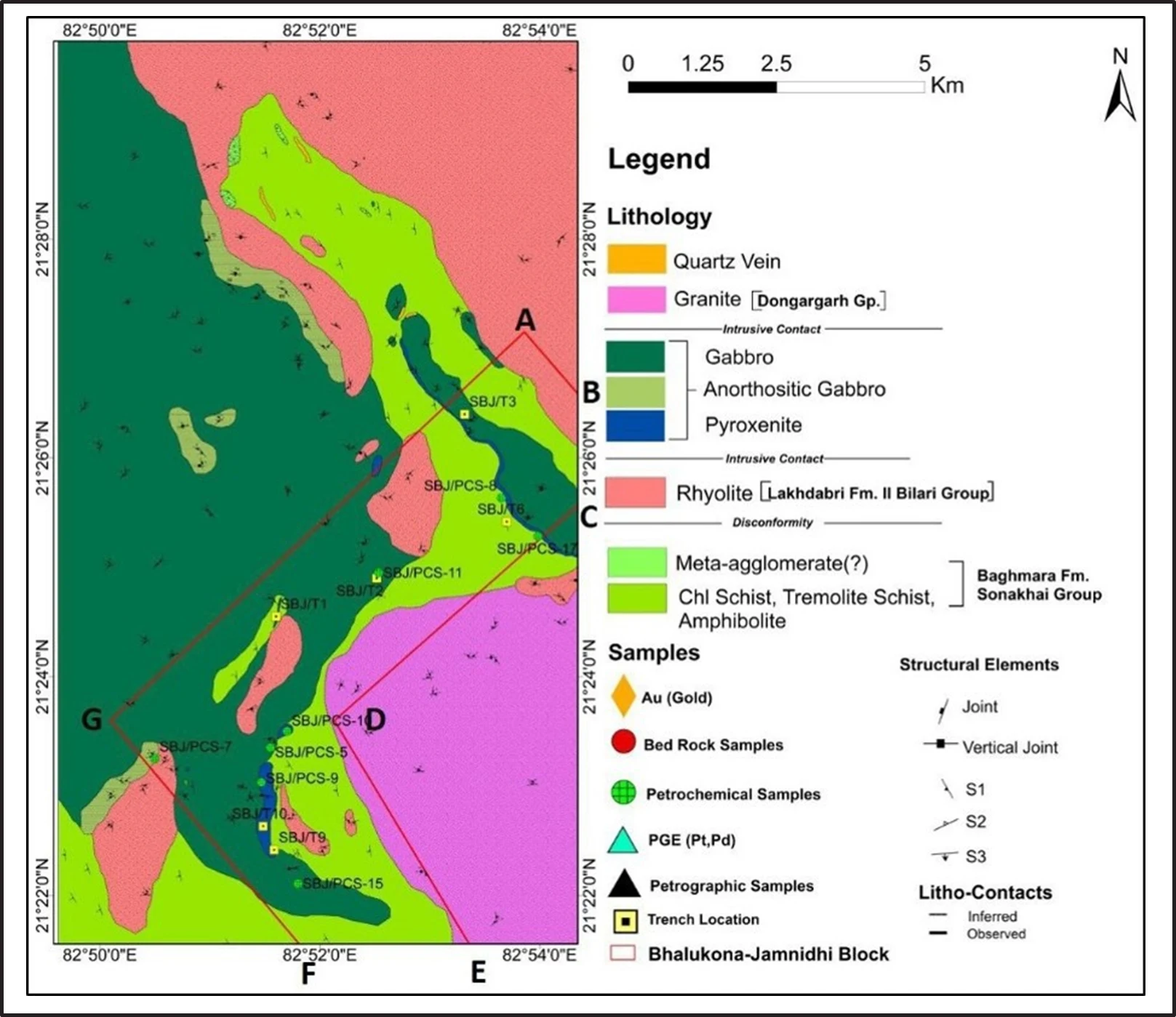
The Bhalukona-Jamnidih block forms a part of Neo-Archean Sonakhan Schist Belt in the NE fringe of Bastar Craton (Figure 29). The Sonakhan Belt contains wide spectrum of volcano-volcanoclastic rocks of Sonakhan and Bilari Group,
mafic-ultramafic intrusive
bodies, undeformed granitoids, younger dykes and quartz veins. The rocks of Sonakhan Group are represented by talc-chlorite schist, chlorite schist, tremolite schist, meta-olivine websterite, and meta-agglomerate. These rocks are disconformably overlain by acidic rocks of Bilari Groups.
The rocks of Bilari Group represent mostly porphyritic/non-porphyritic rhyolite and rhyolitic breccias. These volcano-volcanoclastic sequences have been intruded by large mafic-ultramafic magma of largely gabbro, anorthosite gabbro, and pyroxenitic composition. The mafic ultramafic suites have been further intruded by undeformed granitoids of Dongargarh Group and subsequently by younger dykes, quartz, and epidote veins.
Primary sulphides occurring in the form of disseminated pyrite, arsenopyrite and chalcopyrite observed in freshly broken surface of pyroxenite and gabbro and in ultramafic rocks. Mineralisation occurs mainly in the form of blebs and dissemination of sulphides in pyroxenite and gabbro variants.
Disseminated sub-microscopic and microscopic chalcopyrite, pyrrhotite and pyrite sulphide grains are present in quartz-feldspathic veins, acid volcanic rocks, gabbro, pyroxenite and metapelite schist.
Exploration by Deccan Gold
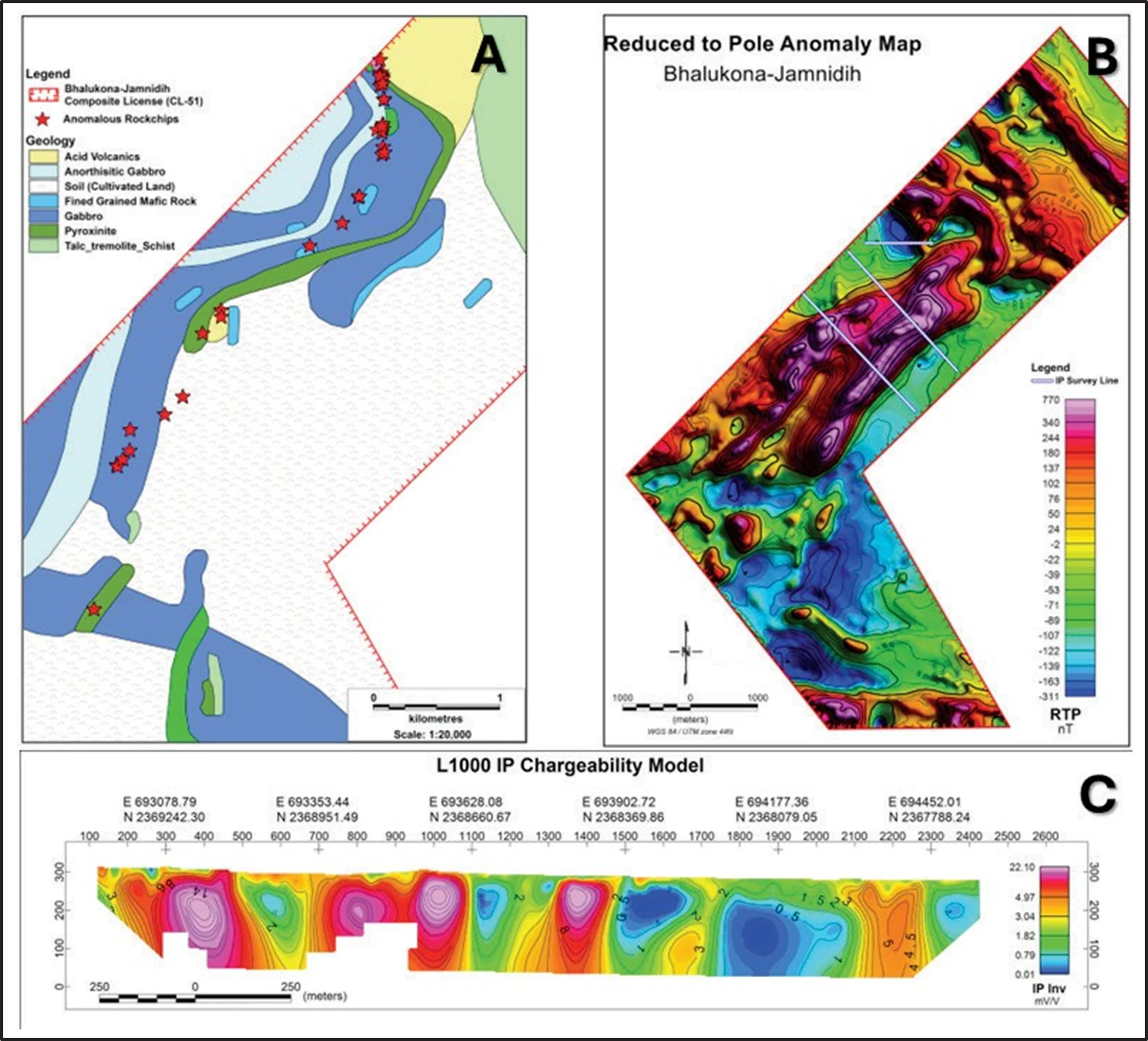
- Rock chip and soil sampling has delineated an approximately 700m long mineralised zone of nickel, copper, and platinum group elements (“PGEs”) (Figure 30).
- Geological mapping has shown early evidence of a layered sequence of the mafic-ultramafic rocks, analogous to nickel deposits such as the Nebo-Babel deposit in Western Australia and the Ahmavara Ni-PGE mine in Finland.
- Drone magnetic surveys highlight potential for repetition of favourable lithological units under soil cover south of the delineated mineralised zone.
- A geophysical induced-polarisation (“IP”) survey returned signatures that suggest multiple zones of sulphide mineralisation, some which extend to 300m below surface.
Deccan Gold will drill the primary target area as soon as local harvest season is completed and will also begin soil sampling to test for potential repetitions of the Ni-Cu-PGE mineralised zone.